
News
The latest in Legal History
Stay up-to-date with the latest news from the Louvain Lab for Law, History and Society (LHS). Discover news and notices about publications, projects, events, careers and much more.
Stay up-to-date with the latest news from the Louvain Lab for Law, History and Society (LHS). Discover news and notices about publications, projects, events, careers and much more.
Discover the news

Job opportunity for a Postdoctoral researcher
Following the award of an FNRS-DFG-WEAVE-research grant (nr. 40037062), we invite applications for a part-time postdoctoral position (80%, three years) on a project entitled The Role of Ius Commune in Asia: Law and Economy in the Casuistry of Goa (1563-1606). The postdoctoral researcher will be based in Louvain-la-Neuve, while collaborating closely with a PhD-researcher based in Bonn.

Doctoral defence – Wout Vandermeulen
On Friday 5 June 2026, Wout Vandermeulen, a member of the Louvain Lab for Law, History and Society, will defend his doctoral thesis in law, completed under a joint supervision arrangement between KULeuven and UCLouvain. His thesis, supervised jointly by Wouter Druwé and Wim Decock, is entitled: The natural roots. The early modern framework of competition-law thinking (16th-18th centuries) and its reception, with a specific focus on German Ordoliberalism (20th century). Congratulations!
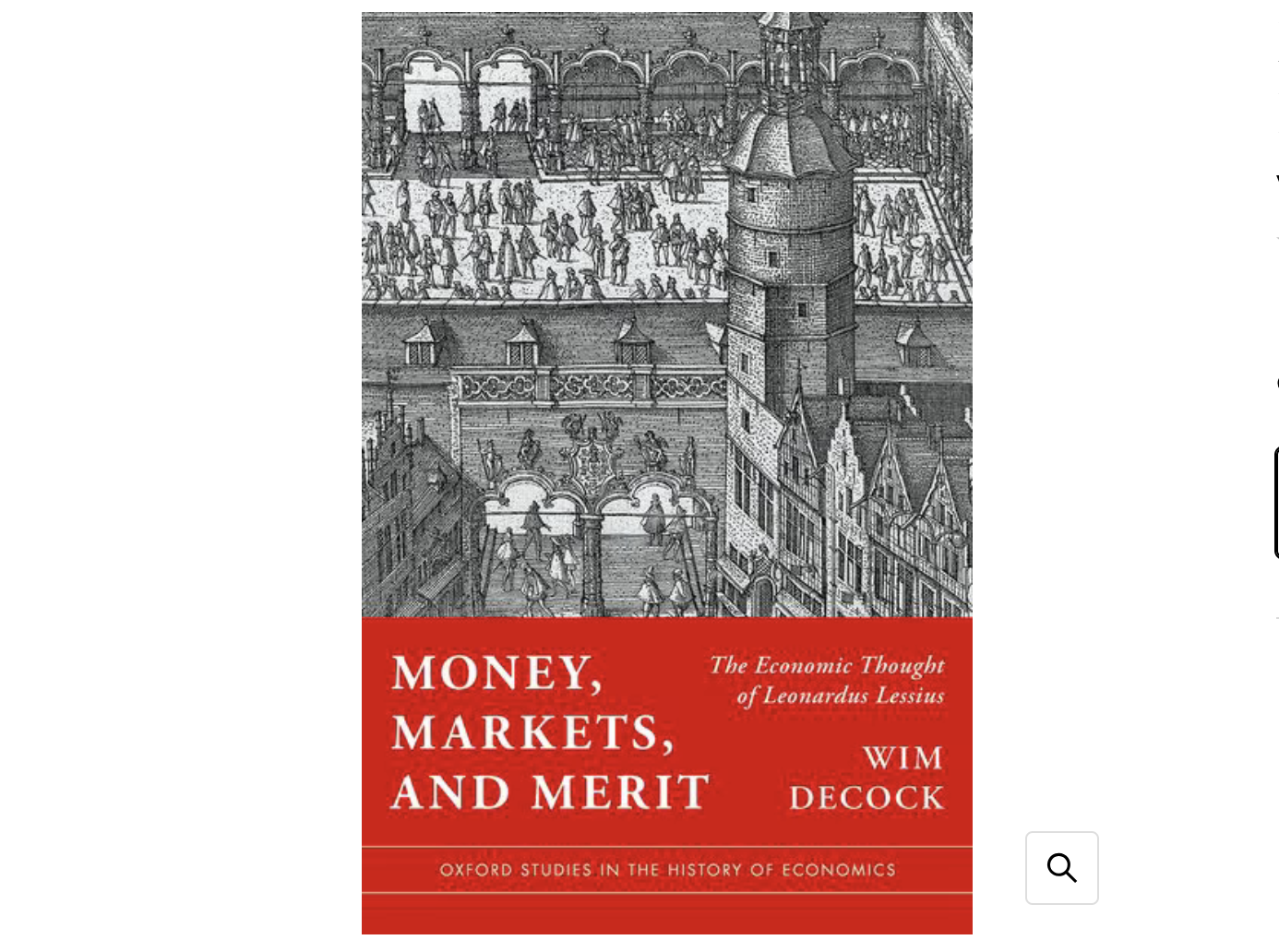
New publication: Wim Decock, Money, Markets, and Merit. The Economic Thought of Leonardus Lessius, Oxford, Oxford University Press, 2025.
To understand the genesis of the modern economy, we must also investigate its normative foundations. More than a century after Max Weber’s The Protestant Ethic and the Spirit of Capitalism, the pursuit of this key methodological intuition remains unfinished. This book revisits the legacy of a neglected protagonist in the history of economic thought: Leonardus Lessius (1554-1623). Lessius’ work provides unique insight into the normative roots of modern economic thought. In a context characterised by the globalization of trade, the rise of stock exchanges, and profound political and religious upheavals, merchants, bankers, and princes eagerly sought his advice to navigate the New World. Praised by Joseph A. Schumpeter as a ‘father of modern economic analysis’, Lessius became known in his own time as the ‘Oracle of the Netherlands’. His main treatise, ‘On Justice and Law’, quickly gained the status of a reference work due to the clarity of its economic observations and Lessius’ brilliant mastery of legal and moral reasoning. He offered practical solutions to a wide range of cases of conscience related to speculation, insurance, insider trading, subprime debt, interest-taking, abuse of market power, monopolies, public banks, safe investment vehicles, and many other economic and financial issues. It certainly was not his intention to turn the whole world into a competitive market without any limits as Lessius deplored humanity’s inclination to succumb to the ‘sacred hunger for gold’. However, he did wish to encourage effort, hard work and clever dealings, thus contributing significantly to the normative justification of modern commerce and finance. In a time marked as much by fierce debates on grace and free will as by doubts about the legitimacy of the first global economy, Lessius offers a glimpse into the interconnectedness between ideas on spiritual salvation and material prosperity.
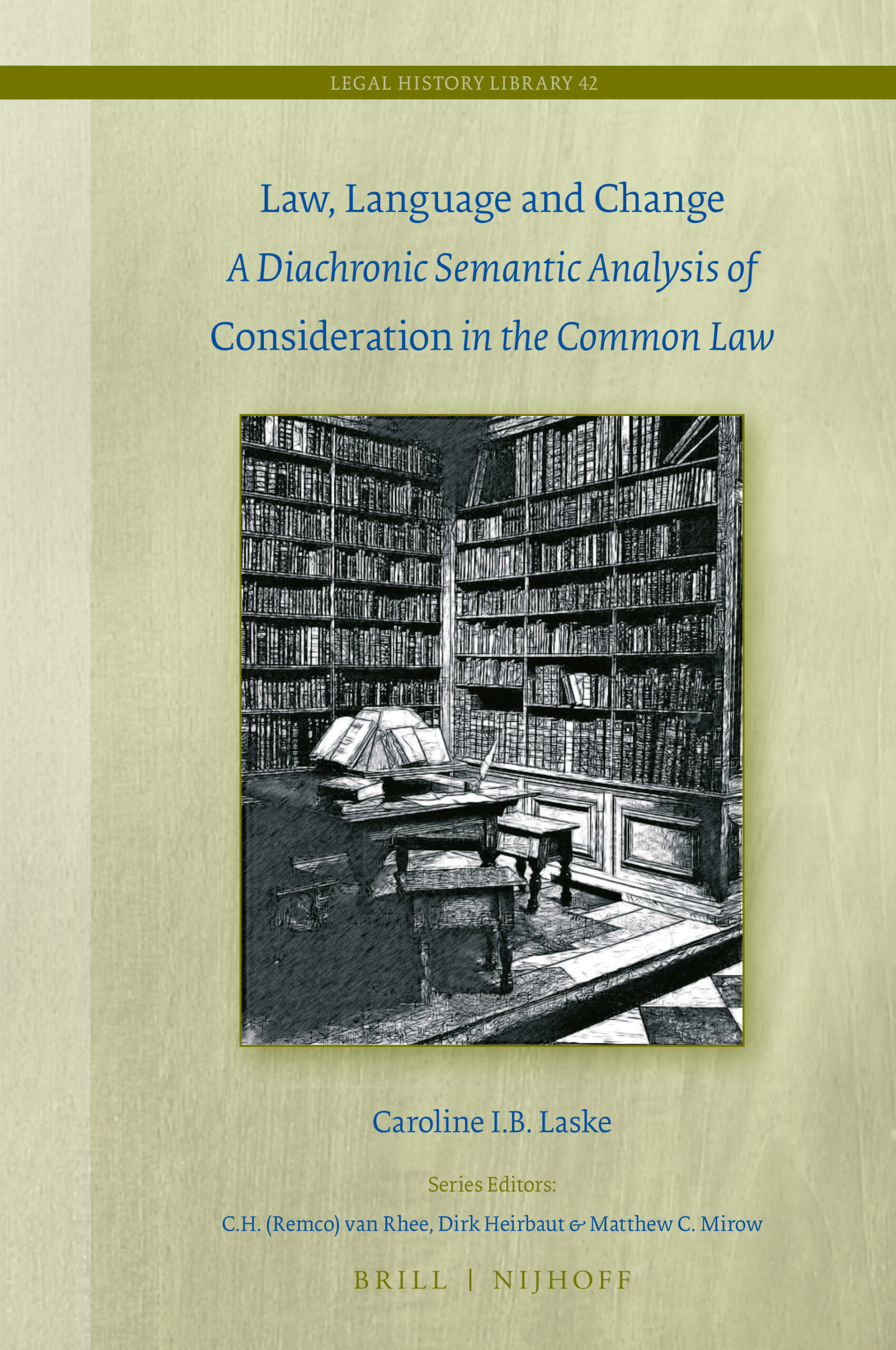
New publication: Caroline Laske, Law, Language and Change. A Diachronic Semantic Analysis of Consideration in the Common Law, Leiden, Boston, Brill-Nijhoff, 2020.
In this monograph, Caroline Laske traces the advent of consideration in English contract law, by analysing the doctrinal development, in parallel with the corresponding terminological evolution and semantic shifts between the fourteenth and nineteenth centuries. It is an innovative, interdisciplinary study, showcasing the value of taking a diachronic corpus linguistics-based approach to the study of legal change and legal development, and the semantic shifts in the corresponding terminology. The seminal application in the legal field of these analytical methodologies borrowed from pragmatic linguistics goes beyond the content approach that legal research usually practices and it has allowed for claims of semantic change to be objectified. This ground-breaking work is pitched at scholars of legal history, law & language, and linguistics.
Wim Decock appointed as new Regius Professor of Civil Law at the University of Oxford

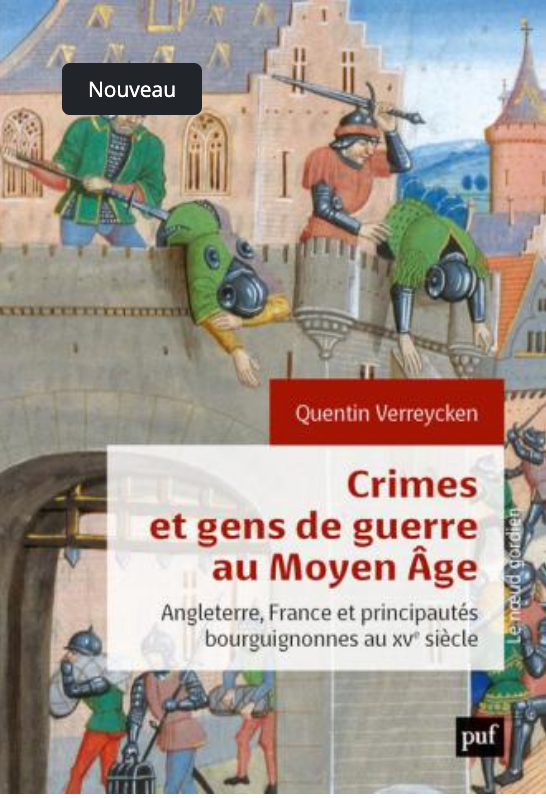
New publication: Quentin Verreycken, Crimes et gens de guerre au Moyen Âge, Paris, Presses universitaires de France, 2023.
En raison de la violence extrême dont il est capable, l’homme de guerre incarne l’une des grandes peurs de la société de la fin du Moyen Âge. Au sortir de la guerre de Cent Ans, dans l’Angleterre, la France et les principautés bourguignonnes du xve siècle, il devient urgent pour les pouvoirs publics de réformer les armées et d’encadrer l’usage légitime de la force publique. Les excès des gens de guerre en dehors du champ de bataille sont désormais considérés comme des crimes devant être sévèrement punis par la justice. Dans ce contexte de renforcement de la discipline militaire, les monarques anglais, français et bourguignons continuent pourtant à accorder fréquemment le pardon à leurs soldats. Loin d’être le signe d’un éventuel laxisme du pouvoir royal ou princier, les centaines de lettres de rémission et de pardon octroyées aux gens de guerre se révèlent au contraire un important instrument de régulation des armées. À partir de cette documentation exceptionnellement riche, ce livre interroge les liens entre violence guerrière, justice et pardon, et offre un regard nouveau sur les gens de guerre et leurs crimes à la fin du Moyen Âge.
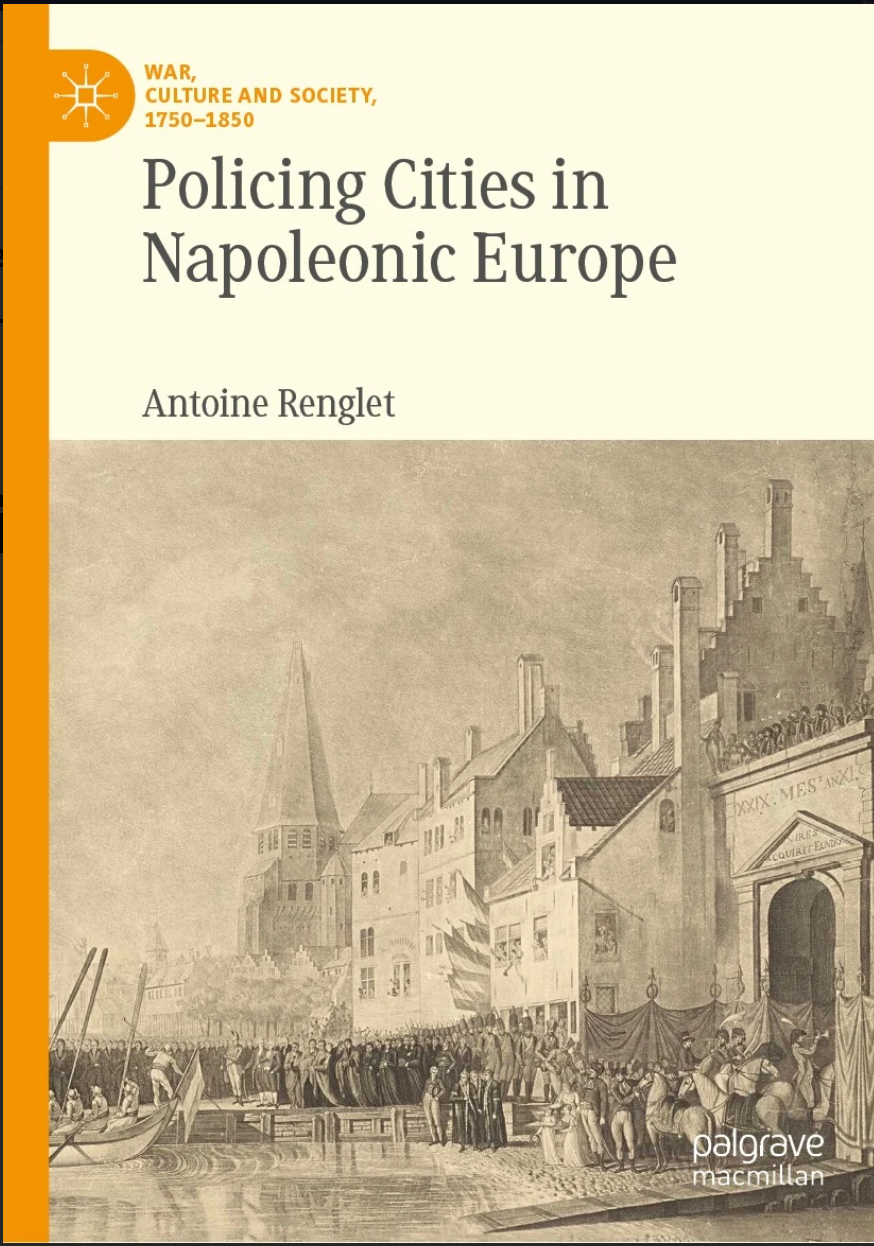
New publication: Antoine Renglet, Policing Cities in Napoleonic Europe, Cham, Palgrave-Macmillan, 2023.
This book shows how the police functioned in the cities of the Napoleonic Empire. Shifting attention away from political repression, it focuses on the men who embodied this institution and made it work day-to-day. Based on extensive archival research, the book shows how the Napoleonic police were indeed an instrument of power, but also a profession and a service to the public. Traditionally associated with the image of Joseph Fouché and with political surveillance, the Napoleonic police, when studied from the local level, thus reveals itself to be much more complex and oriented simultaneously towards both the preservation of the regime and maintaining good urban order.